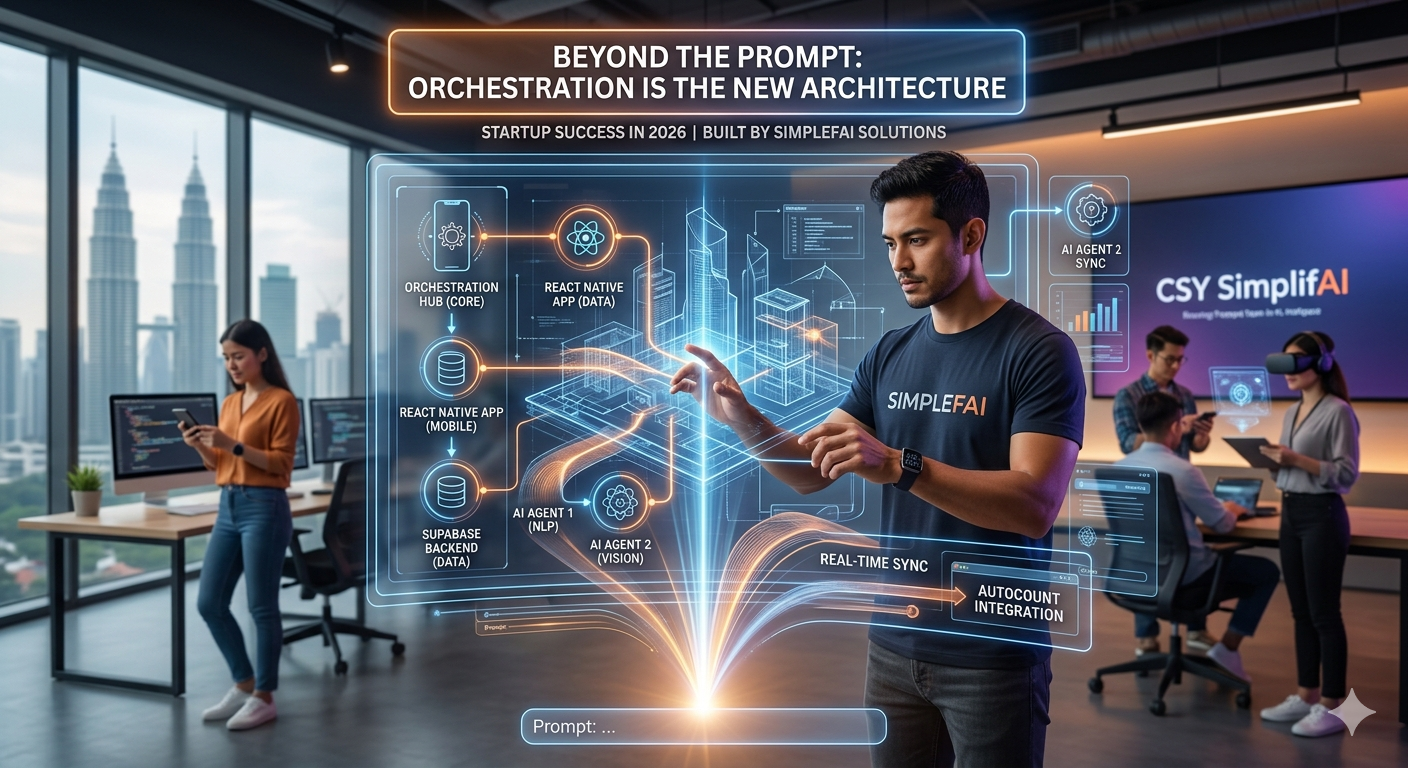
Production AI is not a better demo. It is an LLM system you can score, replay, feed with trustworthy data, orchestrate without chaos, and roll back when a prompt or a provider shift goes wrong. The last two years of enterprise AI were a demo festival. Impressive chats. Polished slideware. Then a quiet stall when the same system had to answer real customers, in real time, with someone accountable when it was wrong.
The usual mistake is starting with model selection—GPT versus Claude versus whoever shipped this week—before anyone has specified the system that will hold that model. Sandipan Bhaumik, a data and AI technical lead at Databricks, put a name on the gap in The Production AI Playbook: production AI is an engineering problem, not a bake-off. The five pillars below are the scaffolding we use when a startup is past the prototype and needs something they can debug, audit, and improve. That discipline is what teams now call LLMOps.
If you want the wiring patterns first—workflows versus agents, graphs versus chains—read our companions on how to build effective AI agents and how AI systems actually stack. This post is the layer those architectures sit on: measurement, traces, data, orchestration, and governance.
Why AI Demos Fail in Production
AI demos fail in production because they skip observability, evaluation, and governance. Before you name pillars, name the failure modes. Most stalled projects share the same three holes.
- Observability. If you cannot replay every tool call and retrieval that produced an answer, you cannot debug it—and in regulated industries you often cannot ship it.
- Evaluation. “Accuracy” is not a metric. Without a number tied to a business outcome—deflection rate, groundedness, time-to-resolution—you have no loop to improve against.
- Governance. When the agent hallucinates a fee, leaks a phone number, or quietly double-charges an API, who owns the incident? If that sentence has no owner, you do not have a production system.
If you cannot replay a failed conversation in minutes, you are not production-ready. You have a demo with a longer timeout.
Pillar 1: AI Evaluation Is the Spec
Write the success criteria before you write the first prompt. Not “be helpful.” A target: 85% grounded answers on a labeled set, 60% of support tickets deflected without a human, zero PII in outbound messages. Those numbers are the spec. The model is an implementation detail you swap later.
A usable eval stack has three layers. Skip any one and you will ship a system that looks fine in a spreadsheet and fails in a ticket queue.
Deterministic checks
Cheap, fast, no LLM required. Format of emails and phone numbers. Schema of the JSON the agent must emit. PII detectors on the way out. These are the tests you already know how to write. Run them on every response. They catch the embarrassing class of bugs that no “semantic score” will save you from in a demo.
Semantic checks (LLM as judge)
Groundedness, safety, relevance to the question asked. A second model scores the first against a rubric and, where you have them, expected answers from a golden set. Keep the judge model distinct from the production model so you are not grading your own homework. This layer is slower and noisier than regex—use it where “correct” is a judgment, not a regex.
Behavioral checks
Did the agent call the right tool? Did it loop? Did it hit the same expensive API twice to answer one balance question? Semantic scores can look green while the trace shows a $0.40 round-trip that should have been a cache hit. Behavioral eval is how you catch that before finance does.
Build the golden set from real traffic—call logs, tickets, the weird phrasing customers actually use—not the five happy-path prompts in the pitch deck. Two hundred labeled cases beats two thousand synthetic ones that never show up in production.
Pillar 2: AI Observability—If You Cannot Trace It, You Cannot Ship It
Observability for agents is not “is the latency under 800ms.” It is a full decision log: user input, retrieved chunks, tool names and arguments, retries, the prompt version that ran, the model id, the output. When a customer asks why they were told their overdraft fee is waived, you need to walk that path—not guess from the final paragraph.
That trace is also how you monitor live. Duplicate operations, sudden tool-error spikes, a prompt version that started leaking PII at 2am: those are dashboard events, not postmortems. In banking, healthcare, and anything with an auditor, tracing is not a nice-to-have. It is the difference between “we think it said that” and “here is the retrieval that caused it.”
Practical bar: a teammate who did not write the agent should be able to open a failed session and explain the failure in under five minutes. If that requires SSH and folklore, the system is still a demo.
Pillar 3: Production AI Data—Question Data vs Tracking Data
Treat AI data as two products, not one lake.
- Question data is what the agent uses to answer: knowledge base, account state, policies, product catalog. Version it. Serve it through APIs you trust. Stale PDFs in a vector store are still stale PDFs.
- Tracking data is what the agent did: traces, eval scores, incident tags. This is the feed for ops dashboards and audits. It must land in one place even if you swap frameworks next quarter.
Humans forgive messy source data. They notice the typo and still help. Agents do not. They will answer the wrong balance with high confidence because the row was wrong and nothing in the prompt said “this table lies sometimes.” Data quality is not a sidecar to the LLM project. In Bhaumik’s telling it eats the majority of the calendar—and skipping it is how you get a confident, incorrect chatbot.
Centralize tracing collection. LangChain today, a custom loop tomorrow, a graph runtime after that: the audit trail should not fork every time the orchestration library does.
Pillar 4: Multi-Agent Orchestration in Production
One agent is a loop. Several agents is a product of failure modes. Pick a pattern on purpose; do not let “we added another specialist” become the architecture.
- Orchestrator–worker. A coordinator decomposes the request and hands work to specialists, then synthesizes. Use when the breakdown is not known in advance (open-ended research, multi-file changes). This is the same idea as the orchestrator–workers rung in our agent patterns ladder.
- Choreography. Independent agents talk over a bus and run in parallel. Lower latency when tasks do not need a boss. Higher chaos when nobody owns the end-to-end SLA.
- Human-in-the-loop. When confidence drops below a threshold—or the action is irreversible—pause for a person. Required in high-stakes and regulated flows; wasted if you pause on every FAQ.
Orchestration is not “more agents.” It is bounded complexity: which pattern, which handoff, which human checkpoint. For why this sits above prompts as the actual architecture, see why orchestration is the new architecture.
Pillar 5: AI Governance, Prompt Versioning, and Rollback
Governance is not a security checklist you bolt on at launch. It is how you pull the system back when it fails.
- Audit trails for every user request—tied to the traces in pillar 2, not a separate PDF.
- PII pre-validation on inputs and outputs, not a hope that the model “usually redacts.”
- Prompt versioning as change management. A prompt is code. Ship it through review, pin the version in the trace, roll back without a heroics channel.
- Model change management. When a provider upgrades the default model, that is a production change. Run it against your golden set before you inherit someone else’s new personality.
Teams that skip this discover it during an incident: nobody can say which prompt was live, the new model drifted on the one policy question that matters, and the rollback plan is “put the old string back in the dashboard.” That is not governance. That is luck that expired. Retention and memory belong here too—see what ChatGPT knows about you for the four data layers your product must name.
How to Deploy Production AI (The Sequence)
A retail-banking chatbot project flipped the usual sequence. Weeks one and two were not model bake-offs. They were an evaluation layer and about two hundred golden cases from real queries. Model selection waited until week seven—after an automated pipeline could say which candidate won on their data, not on a leaderboard. That is the move: measure first, pick second.
Once you are live, you still need an incident protocol. Four steps, mapped to the pillars:
- Detect on eval dashboards—groundedness drop, deflection drop, PII hits, tool-error spike.
- Diagnose from the trace. Which retrieval, which tool, which prompt version.
- Contain with a prompt rollback, a circuit breaker, or a forced human handoff. Fall-tolerance is a feature, not an apology.
- Fix by adding the failure to the golden set so the same miss cannot ship twice.
The test library is a living system. Every production miss that you do not add is a regression you have agreed to repeat. Behavioral evals are expensive, so be deliberate: a thin slice on every pull request, the full suite when you merge to main. Do not skip the full run because the thin slice was green—that is how loops and duplicate API calls sneak through.
FAQ: Production AI vs the Demo
What is LLMOps?
LLMOps is the engineering discipline that takes an LLM app from a working demo to a reliable production service. It covers evaluation, tracing, data quality, orchestration, and governance—so you can debug, audit, and roll back when the model, the prompt, or the provider changes.
Should we pick the model first?
No. Define numeric success, stand up eval and tracing, then let candidates compete on your golden set. Model choice is week seven, not week one.
What is a golden test set for an AI agent?
A labeled library of real user inputs with expected behavior: the answer, the tools that should fire, the PII that must not appear. It grows every time production surprises you. Synthetic-only sets miss the phrasing that actually breaks you.
How is this different from MLOps for classical models?
Same instincts—version, monitor, rollback—applied to non-deterministic text, tool calls, and prompts. You still need data quality and change control. You also need traces of decisions, LLM-as-judge layers, and human checkpoints that classical accuracy dashboards never had to show.
The CSY Takeaway
Production AI is not a better demo. It is a system you can score, replay, feed with trustworthy data, orchestrate without exponential chaos, and roll back when a prompt or a provider shift goes wrong. Start with the spec. Keep the test library alive. Pick the model last.
At CSY SimplifAI Solution, we help startups turn that playbook into shipping architecture—evaluation harnesses, traces you can actually debug, and orchestration that stays observable under real traffic. If you are past the demo and need an AI system you can defend in an incident review, let’s design the smallest version that still holds up.